
Childless at 45 after IVF: My Heartbreak & the Path Forward
If you’ve just received the call that ended everything – or if you’re somewhere in the middle of this brutal process and need to know someone understands what it really costs – this post is for you.
What “Childless at 45 After IVF” Actually Means
The fertility world loves statistics. Success rates. Retrieval numbers. Blast rates. Conversion rates. What it doesn’t prepare you for is the moment those numbers run out. When there are no more eggs, no more cycles, no more versions of “maybe this time.”
Childless after IVF isn’t just a medical outcome. It’s the end of a version of yourself you spent years fighting to become. It’s grief that doesn’t have a name in most languages. It’s loss without a funeral, without casseroles from neighbors, without anyone officially acknowledging that something real and profound has died.
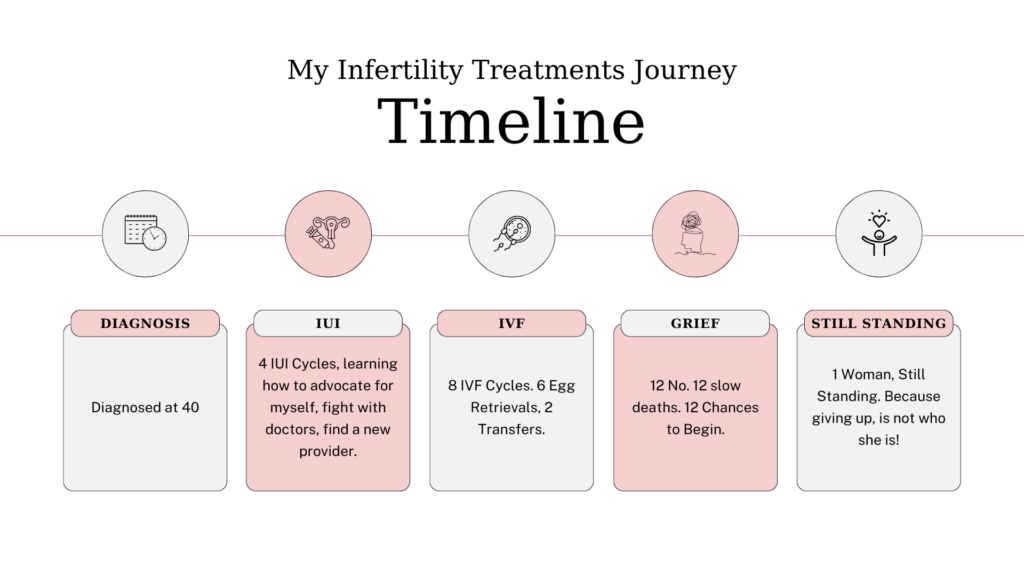
I know this because I lived it. Four IUI cycles. Eight rounds of IVF. One final attempt at 45 that lasted exactly 107 minutes from hope to finality.
This is that story.
Two hours apart. That’s all it took for hope to dissolve into finality. For the IVF heartbreak to take over.
Message 1 – 9:56 AM
“Last attempt and last chance to conceive. It has been a long few years—my body, emotions, and spirituality have all gone through so much. I’m trying to hold on to the last bits of hope, while also trying not to be overly optimistic.”
This morning, I sat in a sterile fertility clinic three hours from home, trying to breathe through the anxiety. I’ve lost count of the injections, the scans, the heartbreak. I’ve whispered prayers into countless waiting rooms. I’ve made promises to a child who never arrived. Today was the last chance. My last egg. My last maybe.
This infertility journey began in 2021. Four failed IUI cycles. Eight emotionally draining rounds of IVF. Each one had its own rhythm of hope and loss, of blood tests and bruised skin, of cautious optimism and silent tears.
This was the final IVF cycle. The last try I had in me – physically, emotionally, financially.
Message 2 – 11:43 AM
“Well, journey is officially over. Egg was abnormal. No one will ever call me mom. I’m a 45-year-old single woman, in debt and childless. Since my 20s I feared being alone and dried inside. Well, maybe destiny proved me right.”
I thought I had prepared for disappointment. But nothing prepares you for the end of IVF. The end of trying to conceive. The end of fertility treatments. The end of the version of me who believed motherhood might still be possible.
There is no roadmap for surviving infertility when you’re single, 45, and childless after IVF. Right now, I don’t need silver linings. I need space to grieve. To scream quietly in my car. To sit with the ache. To feel the weight of a dream that won’t come true.
The Grief No One Warns You About
People talk about the physical toll of IVF – the injections, the bloating, the hormonal chaos. They talk about it not working. What they rarely talk about is what happens to your identity when it’s finally, officially over.
Infertility grief after a failed IVF isn’t like other grief. There’s no body. No date on a calendar that society recognizes. No one sends flowers. Most people around you don’t even know it happened, because you kept it private to protect yourself from having to explain the process, the hope, the fall – over and over again.
What you’re grieving is a future. A version of your life. A child who existed only in the space between hope and reality.
Some things I’ve learned about this kind of grief:
It doesn’t follow the five stages in order. You can be in acceptance on Tuesday and back in rage by Thursday. You can feel fine for three weeks and then see a pregnancy announcement and come completely undone in a grocery store parking lot.
It’s cumulative. Each failed cycle is its own small grief. By the time you reach the final one, you’re not just grieving that last egg – you’re carrying the weight of every single negative test, every cancelled cycle, every hopeful morning that turned into another quiet devastation.
It lives in your body. The clinics, the needles, the waiting rooms – your nervous system remembers all of it. Driving past a fertility clinic can trigger a physical response months or years later. That’s not weakness. That’s what prolonged medical trauma does.
It has no official end date. Unlike grief with a clear loss event, infertility grief resurfaces. A friend’s baby shower. A due date that never was. A birthday that marks another year. The grief doesn’t ask permission to return.
You are not overreacting. You are not too sensitive. What you lost was real.
What Comes After a Failed IVF at 45?
I don’t know exactly what comes next. But I do know this: infertility grief is real. It deserves to be named and held with tenderness.
Maybe… I’ll write. Maybe I’ll write myself into healing. Maybe I’ll write myself into making sense of how I’m feeling.
There will be therapy. There will be soul-searching. There will be moments of rebuilding.
I will search for a new purpose. A new identity beyond motherhood. A new version of me.
Even in this hollow place, I trust that something new will take root. Maybe not the child I dreamed of. But still, something meaningful. Something mine.
Still finding myself. Still discovering Alice.
If You’re Here Because Your IVF Journey Just Ended
I want to say something directly to you, if you’ve just reached your own version of that 11:43 AM message.
You don’t have to be okay right now. You don’t have to find the lesson or the silver lining or the “everything happens for a reason.” You are allowed to be devastated. You are allowed to grieve loudly or silently, alone or with people, in therapy or in your car or in a journal no one will ever read.
The world will move on quickly. Other people’s lives will continue. Pregnancy announcements will keep appearing. And you will have to navigate all of that while carrying something enormous that most people around you can’t see.
A few things that have helped me, not as solutions, but as survival:
- Name what you lost. Not just “the baby” but the life you imagined. The version of you who became a mother. The relationship you thought you’d have. The family holidays. The ordinary Tuesday mornings. Name all of it, because all of it deserves to be grieved.
- Find at least one person who doesn’t need you to be okay. Not someone who will try to fix it. Someone who can just sit in it with you.
- Give yourself a timeline moratorium. For a defined period – a week, a month – no one gets to ask you what’s next. Not even you.
- Know that rebuilding is possible, but it takes longer than anyone tells you. And it doesn’t look like going back to who you were before. It looks like becoming someone new, slowly, on your own terms.
The Question I’m Still Learning to Answer
People ask – kindly, curiously, sometimes clumsily – “So what now? Did you consider adoption? What about egg donation?”
I’ll write more about those questions in depth. About the process of researching every path. About what it means to choose none of them, not from defeat, but from knowing yourself clearly enough to recognize what you can and cannot carry.
For now, the answer is: I’m figuring out who I am when I’m not defined by trying to become a mother. That turns out to be its own long, necessary journey.
And this blog is where I’m writing it.
If this resonated with you, you might also want to read: